
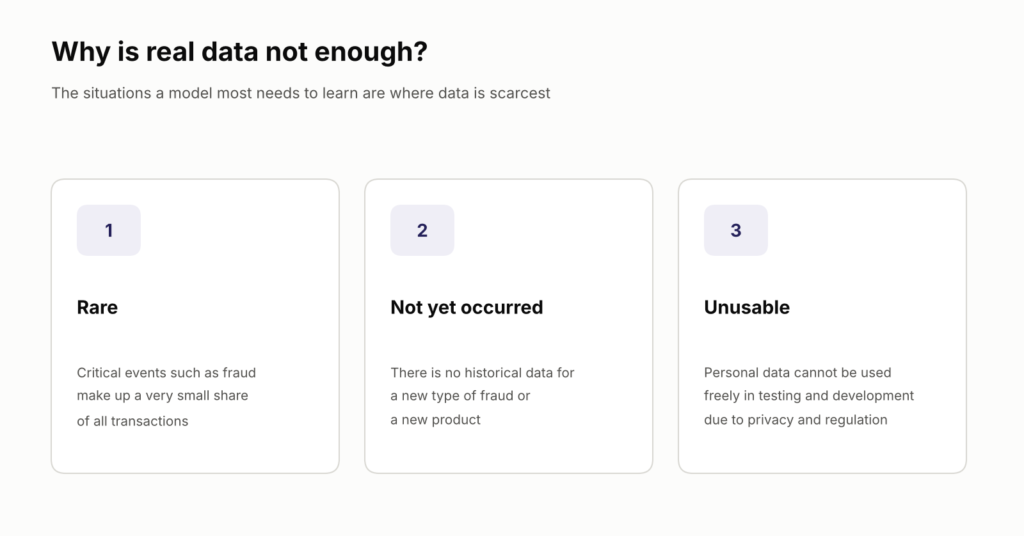
The success of AI models in financial services and insurance depends largely on the scope of the data they are trained on. Yet the situations in which models most need to be accurate are often those where data is most limited: fraud cases are a minority of all transactions, there is no historical data for new types of risk, and the use of customer data in test environments is restricted by privacy regulations.
Hyper-synthetic data is one of the leading approaches to overcoming these constraints. In this article, we look at the concept, how it differs from classic synthetic data, its use cases in the financial sector and the points organizations need to consider.
In brief
Each of these constraints creates a different problem. Rare events prevent the model from seeing enough examples. For new risks, there are no examples at all. Privacy rules, meanwhile, make it difficult to use existing data in development and testing processes.
Access to data is a bottleneck of its own. According to Perforce Delphix’s 2026 report, 99% of organizations need more than one business day to obtain a fresh copy of production data for testing, and 42% wait weeks or even months (Perforce).
Regulators recognize this problem too. In a research note published in April 2026, the FCA, the UK’s financial regulator, stresses that progress in fighting money laundering depends on access to detailed financial data, but that legal and privacy constraints limit the sharing of such data. The FCA’s solution was to produce a fully synthetic dataset, built from real banking data and enriched with realistic money laundering scenarios (FCA).
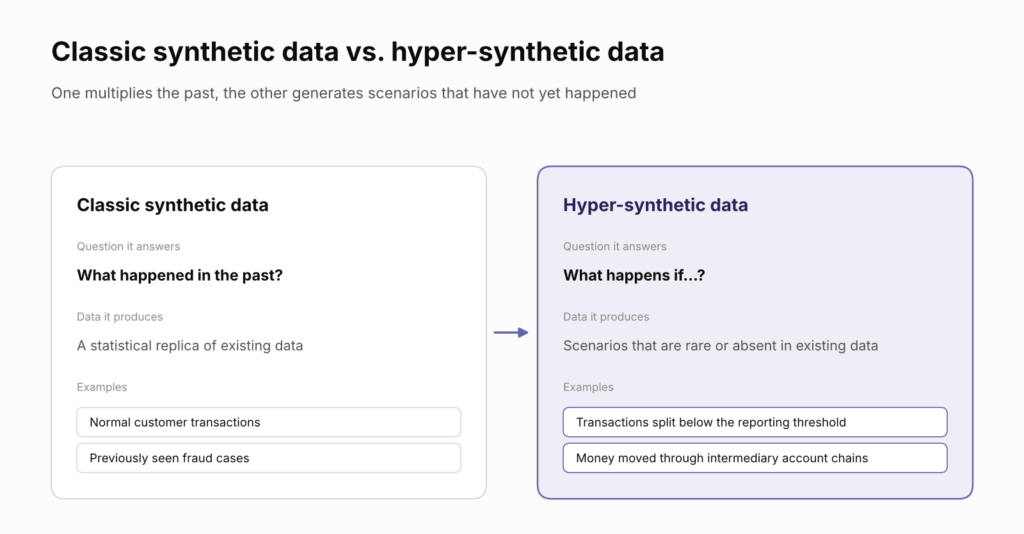
Synthetic data is not a new concept; it has long been used to generate test data and protect personal data. The classic approach imitates the statistical properties of existing data. In other words, it multiplies the data you already have, but it does not produce a situation that has never occurred in the past.
Hyper-synthetic data goes one step further: it deliberately generates scenarios that are rare or entirely absent in real data. The FCA study mentioned above is a concrete example of this logic on the regulatory side: money laundering scenarios are deliberately added to a dataset built from real banking data in order to test detection models.
| Classic synthetic data | Hyper-synthetic data | |
| Purpose | To imitate existing data | To simulate new scenarios |
| Situations covered | Those that have occurred in the past | Also those that are rare or have not yet occurred |
| Typical use | Test data, anonymization | Model training, stress testing, scenario analysis |
Hyper-synthetic data creates the most value in areas where the cost of error is high and real examples are scarce. Prominent uses in the financial sector include:
What these use cases have in common is that models can be tested against possible but not yet observed situations without touching real customer data.
The value of synthetic data is measured not by the volume generated, but by its reliability. Four issues therefore need to be clarified at the start of a project:
The HSD (Hypersynthetic Data) module of Filopi, Nexa’s Agentic Data & AI Platform, generates controlled, labeled synthetic data for scenarios that have not yet occurred, are rare or cannot be used due to regulation. Scenarios are defined in natural language, results are previewed before generation and every generation is versioned. Relationships between tables and business rules are preserved; production data is not touched. The module can be deployed on-prem or in a private cloud.
Let’s prepare your models for scenarios that have not yet happened, together. Request a demo →