
Artificial Intelligence · 5 min read
What organizations expect from artificial intelligence is changing. A few years ago the question was “What can AI tell us?”; today the question has become “What can AI do for us?”. And the answer to this question is, more often than not, AI agents.
However, the value of agents lies not in how autonomous they are, but in placing them in the right job with the right level of autonomy. In this article, we explain where agents are useful in organizations, how much authority they should be given, and what conditions a production-ready agent must meet.
IN BRIEF
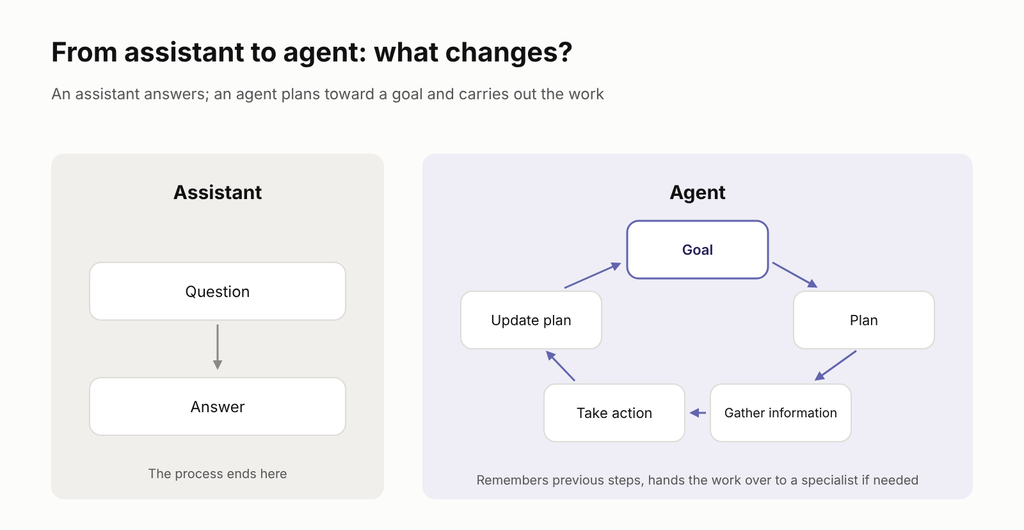
An assistant answers the question asked and stops there. An agent, on the other hand, takes a goal, breaks that goal into steps, gathers missing information from databases or other systems on its own, and initiates an action if necessary. It updates its plan based on the information it gathers and keeps previous steps in its memory (IBM, AWS).
This difference carries concrete meaning on the enterprise side. A customer service assistant can explain campaign terms. A customer service agent, on the other hand, looks at the customer’s history, reviews the relevant documents, and decides whether to resolve the request itself or hand it over to a specialist. In other words, the agent is becoming not just something that provides information, but a structure that takes on part of the work.
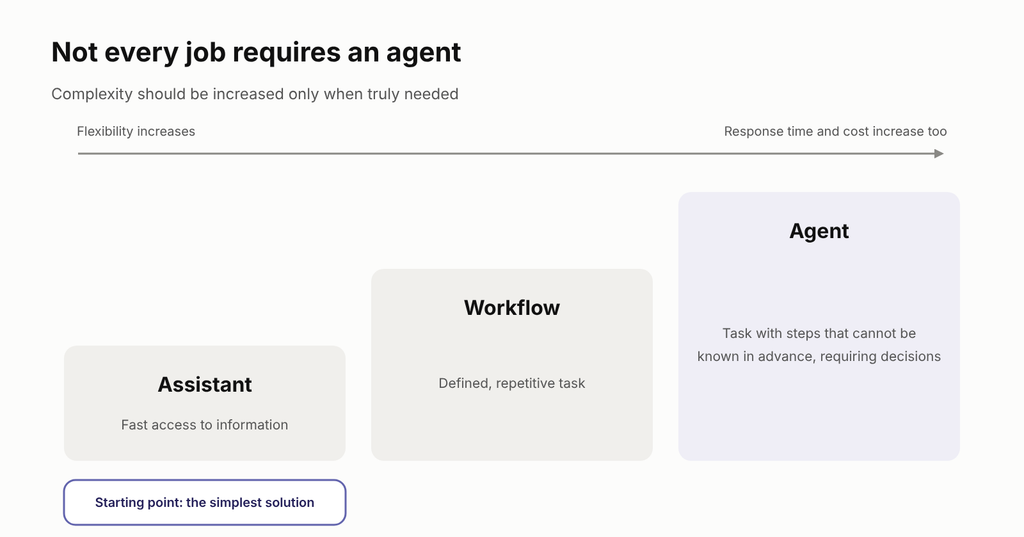
At a time when agents are talked about so much, the most overlooked truth is this: For many jobs, an agent is an unnecessarily complex solution.
For tasks with defined, repetitive steps, a predefined workflow is more predictable and cheaper. An agent, on the other hand, creates value in tasks where the steps cannot be known in advance and where information must be gathered from different sources to make a decision. There is also a price for agents being able to deliver better results: Longer response times and higher costs. That is why the right starting point is the simplest solution; complexity should be increased only when it is truly needed (Anthropic).
| Nature of the task | Suitable approach |
| Fast access to information | Assistant |
| Defined, repetitive task | Workflow or automation |
| Task with steps that cannot be known in advance, requiring decisions | Agent |
Once the decision to use an agent has been made, the next question is how much authority to give the agent. Thinking of this as a choice between “fully automated” and “fully human-controlled” is misleading. Autonomy works more like a graduated setting (SAS):
| Level | What does the agent do? | Role of the human |
| Human-directed | Suggests or prepares the action | Initiates and approves important actions |
| Human-supervised | Executes defined tasks within set limits | Continuously supervises |
| Semi-autonomous | Plans and executes multi-step tasks on its own | Exceptions and risky decisions come to them |
| Highly autonomous | Pursues goals with minimal intervention | Manages through policies and monitoring |
The task itself determines the right level. The more complex a decision is, the more consistent its outcome must be, and the greater its impact, the more important the human’s place in the process becomes. In regulated sectors such as banking and insurance, the right starting point for most organizations is the first two levels, where the agent prepares and the human approves. As trust builds, authority can be increased in a controlled manner.
Agents are now leaving the experimentation phase behind. According to McKinsey’s global survey published in August 2026, among organizations with annual revenue above $1 billion, the share that have scaled agents in at least one business unit rose from 27% to 40% in one year (McKinsey).
The same survey also issues an important warning: Usage is increasing, but financial impact is not following at the same pace. The share of those who say AI contributes to operating profit is 37%, almost the same as a year earlier. What sets organizations that achieve significant value from AI apart from the others is clear: About three-quarters of these organizations have fundamentally redesigned their workflows, while among the others this rate is around one-quarter.
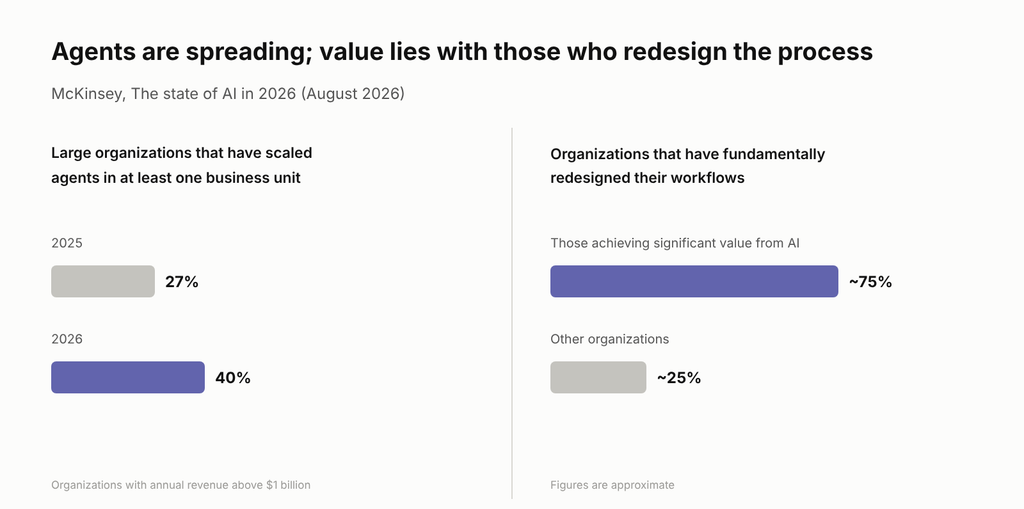
The meaning of this finding is simple. Adding an agent into the existing process is not enough; the process needs to be rebuilt around the work the agent will do and the decisions the human will make.
An assistant only answers, whereas an agent accesses data, initiates actions, and changes outcomes. That is why four conditions must be met before putting an agent into production:
At Nexa, we use AI agents both in our own products and in the artificial intelligence projects we develop for organizations. In these projects, our starting point is not technology but process: First, together, we determine which job truly needs an agent, how autonomous the agent should be, and which data it will rely on. Governance, access permissions, and human approval are not steps added later, but part of the design from day one.
If you are curious about which processes AI agents will create value in at your organization and where you should start, contact us to talk with our team.
Let’s plan your agent journey together. Schedule a meeting →